Ethics Builds Trust, the Most Valuable Currency in a Partnership
The inspiration for writing this blog post was that we see far too many times the big tech companies, because of their sheer size, do pretty much what they want, and any fines imposed on them are added to their bottom line. In our world, that is no way to behave. Recent articles in the tech media point out a value we have held with deep respect in our business for the last 24 years. It’s called Ethics, and we believe it’s even more important today for businesses to find partners that have these values embedded in their culture and the services they provide. While many businesses talk the talk, few put these values into practice in how they work with clients.
“Technology has no ethics. Only people do.” Andrew Keen – How to fix the future
Technology is no longer just an IT issue. It sits at the heart of business continuity, client trust, data protection, and operational resilience. It’s the powerhouse for driving business growth. If the people you choose to manage your infrastructure don’t share your values, do you trust them to be on your side during turbulent times? The most important technology decision a business makes is not which platform to use, which cloud provider to choose, or which security tools to buy. It is who you trust to look after it all.
At Digital Craftsmen, that belief has shaped how we work for 24 years. Peter McBreen’s Software Craftsmanship inspired our name: The New Imperative, published in 2002, the same year we registered our business. “Knowledge must be passed on, skill must be developed over time, and mastery must be earned rather than assumed.” Peter McBreen
McBreen’s message still resonates with us: quality is not manufactured on an assembly line, and trust cannot be bolted on after the fact. It is built through care, skill, consistency, and long-term commitment. This is why we do not view ourselves as a vendor; we see ourselves as a long-term partner. Our role is stewardship: to look after client data, infrastructure, and continuity with the same dedication, focus and seriousness as our clients do for their business.
Why trust matters more in 2026
The 2026 Edelman Trust Barometer reinforces something many businesses already feel: 70% of people are now hesitant or unwilling to trust someone whose values differ from their own. That is not just a social trend. It is a business reality. People are choosing to work with companies that are genuinely built around trust, not simply speaking the language of trust. The distinction matters. In a world where relationships are more visible, and more consequential, ethics is no longer a nice extra. It is part of commercial credibility especially for businesses operating in supply chains.
For us, trust has to be demonstrated in how we work, how we communicate, and how we respond when things go wrong. It means being honest, accountable, and consistent over time. It means being the kind of partner clients know they can rely on, not a supplier that treats them as simply a line in the revenue column.
What happens when trust breaks down
The contrast with much of the wider tech industry is hard to ignore. Big tech companies continue to face lawsuits and regulatory action around privacy, competition, and customer treatment. Broadcom’s takeover of VMware is another example that many SMEs will recognise: customers who had built critical infrastructure on the expectation of stability suddenly faced unilateral contract changes, steep price increases, and hostile terms imposed without them having any say. For the organisations affected, that was not just inconvenient. It was disruptive, expensive, and in many cases deeply destabilising.
That is why the relationship between a business and its technology partner matters so much. The best partners do not simply sell a service and move on. They stay accountable. They think long term. They understand that trust is earned over time, through incidents, migrations, growth, and the moments when support really matters.
Partnership in practice
Let’s talk about one of our clients, Desucla, a fiscal representation company operating in a highly regulated environment. For them, downtime is not just inconvenient; it creates compliance and financial risk. We migrated Desucla to a compliant AWS environment, strengthened security across their stack, and secured them into a 24/7 Security Operations Centre. This provided a trusted foundation for growth, compliance, and operational confidence. We’ve also been their partner through rapid growth, with them every step of the way, helping them to scale their ambitions. You can see more examples in our case studies and our work with financial services clients. The common thread is simple: clients want a partner who understands the weight of their responsibility and will stay with them for the long term.
What the NCSC expects from SMEs in 2026
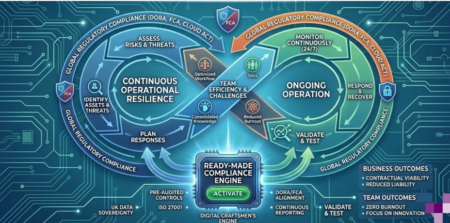
The National Cyber Security Centre (NCSC) has made it clear that all UK businesses, including SMEs, must do more than try to prevent cyber-attacks. Its guidance now places real emphasis on resilience: organisations must be able to demonstrate their capability to detect, respond to, recover from, and learn after an incident. For SMEs, that means more than antivirus software, patching, or a firewall. It means tested backups, recovery planning, incident response, and a partner who can keep the business running when prevention is not enough. In practical terms, cybersecurity is no longer just about defence. It is about continuity.
That is why our services are built around resilience: 24/7 Security Operations Centre, penetration testing, disaster recovery, business continuity planning, managed backups, incident response, free vulnerability audits, and managed AWS & cloud hosting. These are not extras. They are practical tools that help our clients stay protected and recover quickly, and all are supported by a direct 24/7 helpline to a craftsman who already knows your infrastructure and setup. No frustrating automated calls when you need help, regardless of the time.
Trust, verified
Trust should also be independently verified. That is why we hold ISO 27001, Cyber Essentials Plus accreditations, and FSQS verification. For financial services firms and EU-facing businesses, that matters because FSQS supports DORA compliance and reduces supply-chain risk.
Our private cloud hosting also keeps client data under UK and EU jurisdiction, making it GDPR compliant, and out of reach of the US Cloud Act. It matters for businesses that want confidence not only in security, but in sovereignty, compliance, and legal clarity.
What a real partner looks like
A real technology partner is not just there to deliver a project and disappear. They stay close enough to understand your environment, your risks, and your priorities. They act in your long-term interest, not just their own short-term revenue. That is the difference between a supplier and a steward. It is also why ethics matters so much in technology partnerships. Businesses do not just need software, hosting, or security controls. They need people they can trust to stand beside them when it counts.
It is what we have built our business model around. Not quick wins. Not empty promises. Just steady, long-term partnerships, backed by real capability and independently verified trust. It’s why our clients have been with us for years, many for over two decades. We’ve been with them from start-ups to the huge successes they have become, employing thousands.
And we are still by their side, their trusted partner. That’s truly what ethics means in technology today.
FAQ
What does ethics in technology mean?
Ethics in technology means operating with honesty, accountability, and long-term responsibility. It is about more than compliance; it is about doing what is right for clients.
Why is trust so important in technology partnerships?
Because technology partners hold your data, infrastructure, and continuity. If they do not share your values or act in your long-term interests, your business risks being in the hands of people who do not care about your long-term growth.
Why was Digital Craftsmen named after software craftsmanship?
Our name was inspired by Peter McBreen’s Software Craftsmanship: The New Imperative. It reflects our belief that quality, care, and trust are built through skill and long-term commitment, not mass-production thinking.
What does the NCSC expect from SMEs?
The NCSC expects SMEs to build resilience, not just prevention. That means planning for detection, response, recovery, and learning after a cyber incident.
Why does FSQS matter?
FSQS is important because it helps validate suppliers for financial services and supports DORA-aligned compliance for EU-facing businesses.
Finally
If you are looking for a technology partner that values ethics, trust, and long-term stewardship, talk to Digital Craftsmen.
Talk to us today | Call: 020 3745 7706 | Email: [email protected]