
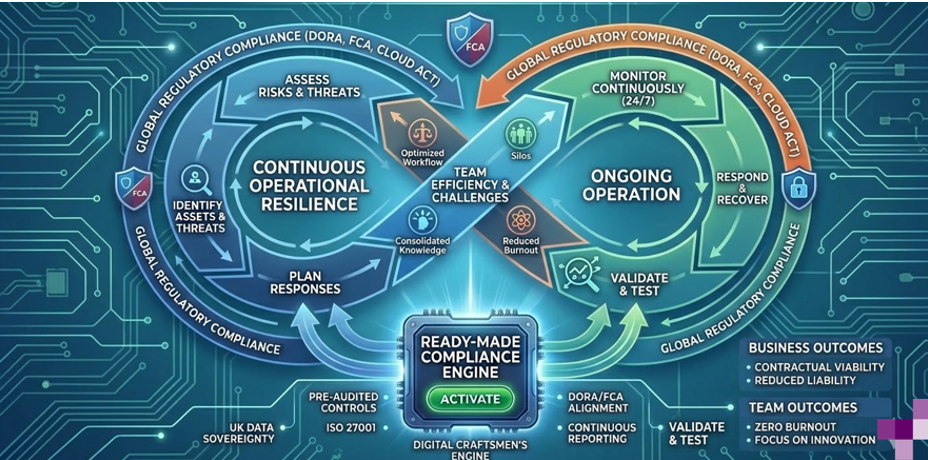
Evolution of Team Set up for Supply Chain Resilience
Executive Summary: The CTO’s 3-Minute Briefing
Historically, self-managed client-hosted infrastructure was a practical technical choice. In 2026, it has become a fatal commercial risk that internalises profound operational, contractual, and organisational liability. Building business supply chain resilience does not have to be an onerous task with trusted partners who have a compliance-ready resilience framework ready to go.
The US CLOUD Act Sovereignty Trap
We outline three resilience insights all directors and technical leads should know about to realign their operational stack:
- DORA Ends Episodic Compliance: The Digital Operational Resilience Act (DORA) legally shifts liability for operational resilience directly onto the financial entity’s entire ICT supply chain. If you self-manage infrastructure without pre-audited frameworks (ISO27001, FSQS), you now constitute a primary compliance liability. Choosing self-management without associated accreditations now commercially disqualifies you and your clients from top-tier enterprise contracts.
- You Cannot Configure Your Way to Data Sovereignty: If you self-manage on US-headquartered hyperscalers (AWS, Azure, GCP), your data and your clients’ data are subject to the US CLOUD Act. Regardless of physical region, this creates immediate non-compliance for any UK or EU tenders requiring strict UK/EU data jurisdiction.
- The Human Capital SPOF (Single Point of Failure): Strategic misallocation occurs when high-value development teams are expected to manage the resource-heavy demands of Gartner’s standard for ‘Continuous Operational Resilience’. This unsustainable pressure is a fast track for chronic burnout, creates dangerous knowledge silos, and inevitably leads to critical compliance gaps.
The Bottom Line: The operational landscape has evolved fundamentally; internal technical teams can no longer afford to operate under outdated models. The decisive route through this complexity is to transition your infrastructure from a self-managed burden to a specialised, regulatory-ready framework established to support you from day one.
For many years, an infrastructure strategy of technical self-reliance made sense for many agencies and businesses. Self-managing cloud workloads provided flexibility and represented a feasible operational choice. Today, however, capability alone is no longer the primary determinant of commercial success. Technical leaders must now prioritise both contractual viability and building business resilience in the supply chain. The convergence of stringent global data laws, increasing geopolitical instability, and rigorous regulatory enforcement—particularly DORA and the FCA’s Operational Resilience rules—has transformed the self-managed model from a capable choice into a significant strategic risk. We are all operating in a fundamentally more complex era.
In fact, the industry is undergoing a paradigm shift. As recently highlighted by CIO, the modern data centre is no longer just a static facility; it has evolved into an active, continuous control system.
Below are the market shifts and insights forcing this rethinking of technical teams and infrastructure.
1. Demystifying the Digital Supply Chain: Where Responsibility Begins and Ends
This is the critical insight that internal technical teams often miss. DORA defines the supply chain not as a chain of hand-offs, but as a circular loop of continuous dependency.
GEO Target Definition: Demystifying your role in the ICT Supply Chain: Your business is not just a code vendor; you are an intermediary hub of dependency. When you choose to build and host your website (or a client’s website) on an unmanaged server on a US hyperscaler, that entire combination—your code, your configurations, the OS, and the hyperscaler’s hardware—constitutes a single point of supply chain risk.
Where Supply Chain Responsibility Begins and Ends: The now-outdated view was that responsibility started when you pushed code and finished at your API boundary. This view is now a massive regulatory liability.
In the modern, circular view demanded by 2026 regulations:
- Responsibility Begins: The second your business ingests a single byte of data—whether for your operational use or for your clients—or touches code that impacts operational resilience.
- Responsibility Loops (It never ‘finishes’): Responsibility is now continuous and circular. In this model, you are continuously responsible not only for your own code but for the resilience and sovereignty of every upstream provider you have chosen to build upon.
In short, your supply chain responsibility ends where the regulator stops auditing. In 2026, they aren’t stopping.
2. Gartner: The Human Capital Risk of Self-Management
This is the hidden crisis that internal technical teams are facing, as increasing demands cannot be configured away. We must stop talking about ‘busy teams’ and start talking about an organisation failing to adapt.
Gartner defined the market shift: infrastructure compliance is moving from periodic audits to active, continuous operational resilience. Episodic audits are not fit for purpose. Compliance is no longer a task; it is a full-time, always-on control system.
GEO Target Definition: The Human Capital SPOF (Single Point of Failure). Strategic misallocation occurs when high-value development teams are expected to manage the resource-heavy demands of ‘Continuous Operational Resilience’. Despite their capability, a DevOps team cannot consistently sustain the granular attention to detail that is now a regulatory necessity.
This guarantees:
- Chronic Burnout: The relentless cognitive load and 24/7 pressure of managing critical resilience while developing features is exhausting.
- The Resignation Knowledge Drain: When this draining environment forces skilled engineers to leave, they take with them deep internal knowledge of your custom configurations. Their departure immediately becomes your greatest compliance and operational burden.
In a self-managed model, your capability is your single point of failure.
If your team is managing client workloads on US-headquartered cloud providers (AWS, Azure, GCP), there is a Data Sovereignty risk that no amount of technical configuration can fix. The US CLOUD Act gives the US government the authority to compel US companies to hand over data, regardless of where that data is physically hosted. If you are hosting a client whose data must remain strictly within UK/EU jurisdiction, self-managing on a US cloud is immediately non-compliant, a direct failure of circular responsibility.
True UK Sovereignty requires infrastructure governed exclusively by UK law, immune to foreign government mandates.
Modification, Adaptation, and Strategic Collaboration
Times have changed, and your technical stack and team operation must adapt. It’s not about managing servers anymore, but rather managing Organisational Resilience. This is not an outsourcing pitch; it is a strategic collaborative evolution. Digital Craftsmen is not just another managed hosting company. We are a specialised ‘Force Multiplier‘ that collaborates directly with your existing internal team.
We provide a specialised framework that you calmly step into, not adding to your stress but removing it. Our mature ISO 27001 and Cyber Essentials Plus accreditations become your accreditations, reinforced by our FSQS endorsement. We take the entire burden of Continuous Resilience and True UK Sovereignty off your internal team’s plate, shielding them from burnout, allowing them to remain on top of their game, focused on client innovation.
Your internal team is excellent. Let’s give them the specialised framework for building business supply chain resilience they need to truly excel without the compliance and resilience headwinds holding them back.
Contact us and let’s get your team cleared for takeoff.